Client Utilization Rate: The Number That Reveals Whether Your Business Model Actually Works
Most service founders set an hourly rate using a simple formula: annual revenue goal divided by available hours. It feels logical. It is structurally wrong.
The calculation ignores a foundational constraint that every service business operates inside: hours are finite, and client-serving hours are always fewer than total available hours.
That gap — between available time and billable time — is where margin quietly disappears.
What Client Utilization Actually Measures
Client utilization is not a productivity metric. It is not about how many hours you work per day or how efficiently you move through a task list.
It measures one specific ratio: the percentage of your available working hours that are actually spent on revenue-generating client work.
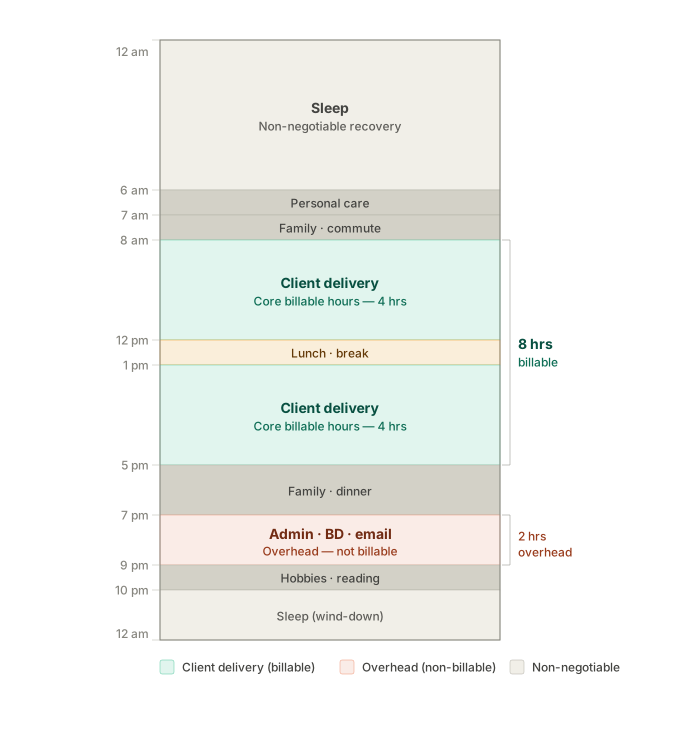
Available working hours are not 24. They are not even 8 hours times 5 days. Available hours are what remain after sleep, personal obligations, and the non-negotiable maintenance of a functioning human being — consistently, across a full year.
From that realistic baseline, you subtract everything that is not direct client delivery: business development, administrative work, finance, email, internal meetings, proposal writing, invoicing. For most solo and small-team operators, this consumes 20 to 40 percent of every working week.
The result is your true client utilization rate. And it is almost always lower than founders assume.
The Math Most Founders Get Wrong
Here is the standard calculation most service founders use to set their rate:
Revenue goal: $250,000 Available hours: 40 hrs/week × 50 weeks = 2,000 hours Calculated rate: $125/hour
This rate will not produce $250,000. It assumes every available hour is a billable hour. That assumption is false for every service business without exception.
A more structurally honest version of the same calculation:
Revenue goal: $250,000 Available hours: 2,000 Estimated utilization: 70% (client-serving hours) Realistic billable hours: 1,400 Required rate to hit goal: $178/hour
The difference between $125 and $178 is not a minor adjustment. It is the difference between hitting your revenue target and falling 30 percent short while working the same number of hours.
Most founders discover this shortfall at the end of the year, not at the beginning. By then, the pricing has already been set, the engagements are running, and the only available lever is volume — which requires more hours and accelerates the problem.
Why Hours Are Not a Scaling Strategy
The instinct when revenue falls short of a goal is to work more. Take on another client. Add a project. Extend the week.
This is the structural trap that utilization analysis exposes: hours have a hard ceiling. There are 24 in a day. Sleep, physical recovery, and basic function are not optional. The effective ceiling for sustainable client-serving hours — without systematic burnout — is lower than most founders build their business models around.
This is not a motivation problem or a discipline problem. It is an arithmetic problem.
The service founders who break out of this constraint do not do so by finding more hours. They restructure around three different levers: pricing precision (charging what the delivery actually costs), capacity modeling (knowing exactly how many engagements the current structure can profitably absorb), and offers that are partially or fully disconnected from direct time — productized services, tiered deliverables, or async delivery models.
None of these levers can be pulled without first understanding your real utilization rate. You cannot price correctly without knowing what proportion of your time is actually available for client work. You cannot model capacity without that same baseline.
AI Is Changing the Utilization Equation — But Not the Way Most Founders Think
There is a common framing in the current AI conversation that goes roughly like this: AI makes you faster, so your hours go further, so your effective capacity increases.
This is partially true and structurally incomplete.
AI does compress time-per-task on many deliverables. A founder using AI effectively can produce in three hours what previously required six. That compression is real and the efficiency gain is meaningful.
But the utilization equation has two sides. The numerator — client-serving hours — can increase when AI handles internal tasks that previously consumed billable time. The denominator — available hours — does not change. There are still the same number of hours in the week.
Where AI creates genuine financial leverage for service founders is not in hours saved. It is in margin per hour. When AI handles the portions of delivery that do not require your specific expertise, your effective capacity for high-margin work increases without requiring you to work more.
The distinction matters because clients — informed by the same AI narrative — are beginning to question whether fees should decrease as AI handles more of the work. Founders who cannot articulate the actual value composition of their delivery (what is AI-assisted versus what requires direct expertise) are losing pricing leverage. Founders who can model and communicate this clearly are not.
Utilization analysis is the foundation of that conversation. It begins with understanding what your time is actually worth and what each hour of client-facing work is actually costing you to deliver.
The Three Numbers That Give You Real Visibility
If you have not calculated these for your current business, start here.
1. Your actual utilization rate. Track a representative two-week period. Every hour. Categorize each block as client delivery, business development, administration, or personal. Calculate the percentage of total working hours spent on direct client work. For most solo operators, this lands between 55 and 75 percent. If it is below 50 percent, the administrative and overhead load is the primary constraint on revenue — not client volume. The Client Utilization Calculator runs this calculation automatically.
2. Your true effective hourly rate. Take total revenue for the last 90 days. Divide it by total hours worked — not just the hours you billed. Include every scope creep hour, every revision round, every client email, every proposal that did not close. The resulting number is your actual effective hourly rate. For most service founders, it is 30 to 50 percent lower than their stated rate.
3. Your capacity ceiling. Based on your realistic utilization rate, how many client-serving hours per month can your current structure actually sustain without degrading delivery quality or producing burnout? That number, multiplied by your required hourly rate (the structurally honest version), gives you the realistic revenue ceiling of your current model.
If that ceiling is below your revenue goal, you do not have a sales problem. You have a structural problem. More clients will not fix it — they will accelerate the pressure until something breaks.
Structure Reveals What Effort Conceals
The founders who operate with utilization visibility make better decisions at every constraint point: when to take on new work, when to reprice, when to exit an engagement that is consuming disproportionate time, when the current structure has reached its ceiling and something needs to change.
The founders operating without this visibility make the same decisions — but based on how busy they feel and what their bank balance looks like on the day the decision is due. That is not a judgment. It is the default state for most service businesses that were built through client relationships and expertise, not through financial infrastructure.
Utilization is not a metric for large organizations with workforce planning departments. It is a foundational number for any service business where time is the primary input — which is every consulting and professional services firm regardless of size.
The free Financial Execution Alignment Check includes specific questions on capacity tracking and utilization visibility. If you cannot answer them confidently, that is where the structural work starts.
Related reading
- What Is Client Utilization Rate and Why Does It Matter More Than Your Revenue Number
- How to Know When You're Actually Full
- Your Utilization Rate Is Fine. Your Effective Rate Isn't.
Start with the free Financial Execution Alignment Check — five minutes to see where your financial infrastructure is and isn't working.
Find out where your financial structure stands.
Take the free Financial Execution Alignment Check.
Take the free diagnostic →